


The Hidden National Security Risk: Workforce Readiness

When most Americans think about national security, they naturally think about our
military, intelligence agencies, cybersecurity, critical infrastructure, or advanced
technologies. Few stop to consider one of the most important factors supporting all
those capabilities: our workforce.
Every day, organizations responsible for protecting our nation face increasing competition for highly skilled talent. From geospatial intelligence and artificial intelligence to engineering, advanced manufacturing, logistics, data science, and cybersecurity, the demand for technical professionals continues to outpace the supply. This challenge is no longer simply an education issue, it is a strategic issue with long term implications for our nation's economic competitiveness and resilience. The reality is that technology alone cannot solve this problem.
We can build the world's most sophisticated systems, invest billions in research and development, and accelerate innovation at unprecedented speeds. Yet none of those investments will achieve their full potential without the people who possess the knowledge, critical thinking, adaptability, and leadership required to operate within increasingly complex environments. That is why workforce readiness deserves greater national attention.
Preparing students for the future should begin long before they reach college or begin searching for their first job. Young people need meaningful opportunities to explore how technology, geography, global systems, data, and emerging industries influence the world around them. They deserve educational experiences that encourage curiosity, strengthen problem solving skills, and help them understand the connections between classroom learning and real world challenges. Equally important, workforce development should not be viewed as the responsibility of schools alone.
Universities, employers, government agencies, community organizations, and civic
leaders all have a role to play in developing the next generation of innovators, analysts, business leaders, engineers, entrepreneurs, and public servants. Building a stronger workforce requires collaboration across sectors and a shared commitment to preparing students for opportunities that many have not yet imagined.
At Gateway Global, we believe workforce development is not simply about filling jobs. It is about strengthening communities, expanding opportunity, supporting economic growth, and helping ensure that the United States remains globally competitive in the industries that will define the decades ahead. As technology continues to evolve, the conversation must also evolve.
The question is no longer whether workforce development is important. The question is whether we are preparing students early enough (and intentionally enough) to meet the challenges and opportunities of an increasingly interconnected world. The decisions we make today will shape the workforce that protects, builds, and leads our nation tomorrow.
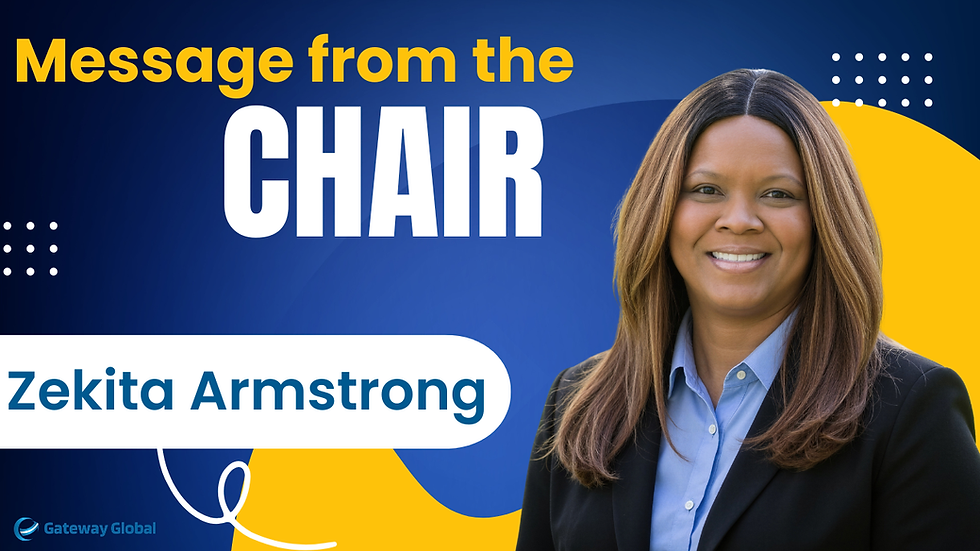
As Chair of Gateway Global, I remain optimistic because I continue to meet educators, industry leaders, public officials, and community partners who recognize both the urgency of this moment and the extraordinary opportunity before us. Together, we can strengthen the talent pipeline that will power innovation, economic prosperity, and national resilience for generations to come. The future of our workforce is not simply an education issue.
It is a national priority.
In Service,

Zekita Armstrong
Founder, Chair
Gateway Global
"The Future of Work Begins Here"
Comments