


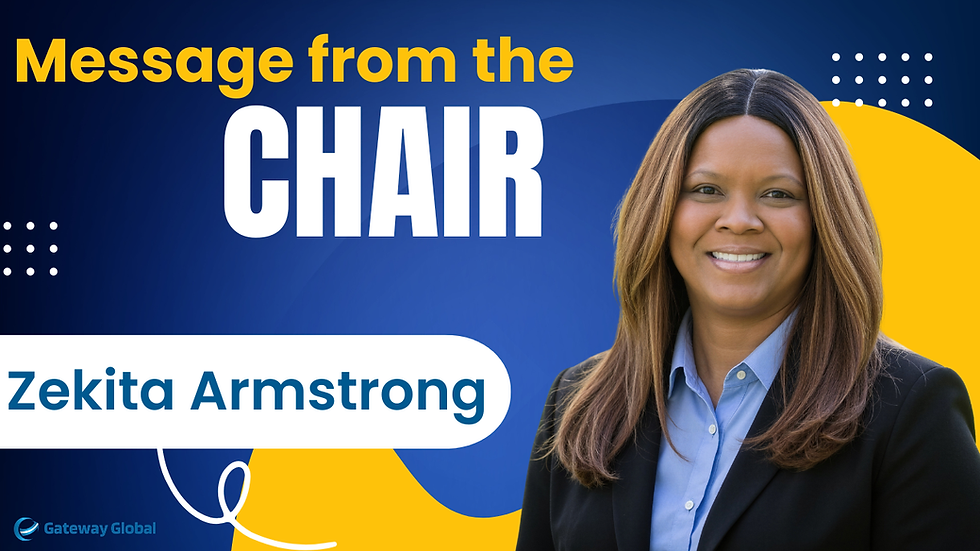
Message from the Chair: Missouri’s Geospatial Moment

There are rare moments when a state finds itself uniquely positioned to lead an emerging sector that will shape the future of economic competitiveness, workforce development, national security, and technological innovation. Missouri is standing in one of those moments right now.
What makes this moment so extraordinary is not simply the presence of one federal institution or one innovation corridor. It is the convergence — the triangulation — of three nationally significant geospatial anchors across our state:
1. The National Geospatial Intelligence Agency (NGA) in St. Louis
2. The United States Department of Agriculture (USDA) & United States Department of Energy (DOE) geospatial ecosystem in Kansas City
3. The United States Geological Survey (USGS) and geospatial research infrastructure in Rolla
Taken individually, each of these represents an important national asset. Together, they form what may become the most strategically important geospatial corridor in the United States and the implications extend far beyond maps or imagery.
Geospatial technologies now sit at the center of:
National defense and homeland security
Agriculture and food systems
Transportation and logistics
Infrastructure resilience
Environmental intelligence
Telecommunications and smart cities
Artificial intelligence and predictive analytics
The future workforce for these industries will require far more than traditional education and technical training. It will require spatial literacy, systems thinking, applied technology skills, and cross-sector collaboration beginning at the K–12 level and extending through higher education, workforce development, and industry partnerships. This is where Missouri has an opportunity to lead nationally, but leadership will not happen automatically. The greatest opportunity in front of us is not simply attracting companies. It is building the workforce ecosystem capable of sustaining long term innovation and national competitiveness needed to remain a leader in the global arena.
That means:
Aligning education systems with emerging geospatial workforce demands
Expanding access to spatial literacy and geospatial learning pathways for youth and young adults
Creating stronger partnerships between state and federal institutions, school systems, workforce agencies, and industry
Developing scalable workforce pipelines that connect underserved metro and rural communities to high growth careers
Positioning Missouri as the nation’s premier talent hub for geospatial and adjacent technologies
If done right and with keen intent, Missouri can become not only a center for geospatial operations, but the national model for geospatial workforce development where it matters most- around U.S. Critical Infrastructure. This moment requires statewide coordination, long term vision, and the willingness to think beyond isolated initiatives.
At Gateway Global, we believe the future of workforce development will increasingly depend on the integration of education, spatial technology, applied learning, and industry connected career pathways. We also believe Missouri has the assets, institutions, and leadership capacity to build something nationally transformative. The question is not whether the geospatial economy will grow. The question is whether Missouri will fully organize itself to lead it. I believe we can.
And I believe the decisions we make over the next decade will determine whether Missouri simply participates in the future geospatial economy — or defines it.
In Service,

Zekita Armstrong
Board Chair
Gateway Global
"The Future of Work Begins Here"
Comments